

Roughly 30–40% of loss-given-default in a vehicle book is decided in a 60–90 day window after the loan disburses — a window most lenders cannot see into. autofinTELL is the post-disbursement intelligence layer that closes it: continuous KYC validation, behavioural early-warning, and precision recovery. It begins with a telematics device the borrower consents to and uses every day — and that consented, living signal is exactly what makes the intelligence continuous and trustworthy.
Underwriting is where a lender concentrates its best people, data, and judgement. Then the loan disburses, the vehicle leaves the lot, and the portfolio goes dark until something breaks. autofinTELL begins with a telematics device the borrower consents to — and reads that signal as a post-disbursement intelligence layer. The reason the signal is continuous and trustworthy is that the borrower wants the device in their vehicle.
The first risk signal most systems surface is a missed payment — by which point income disruption, an address change, or intent to default is already weeks or months old.
Once the vehicle leaves the showroom, the lender has no continuous view of the very collateral securing the loan — where it is, whether it is being used, whether it still matches the borrower’s declared profile.
The vehicle may be hidden, across state lines, or stripped. A blind repossession search runs 30–90 days at ₹15,000–50,000 per attempt, with a low success rate.
Between the stress event and the write-off sits a 60–90 day window. Roughly 30–40% of loss-given-default is made or avoided there — and it is the window you currently operate blind in.
It starts with a telematics device the borrower wants in the vehicle. The borrower consents to it at origination and then engages with it every day — for a theft alert, a teen driver, a delivery record — so it stays powered and trusted. A tracker answers where is the vehicle? On that same consented, living signal, autofinTELL answers the question a lender actually needs: which loans are quietly turning bad? The tracker is the foundation. The intelligence is the product.
| The GPS device — the consented foundation | autofinTELL — the layer built on it | |
|---|---|---|
| Starts as | A telematics device the borrower consents to and uses every day | The same signal, read for post-disbursement portfolio risk |
| Answers | Where the vehicle is, how it is being used | Which loans are quietly turning bad — and why |
| Who it’s for | The borrower — safety, convenience, their business | Your Credit, Collections & Risk functions |
| The data | Vehicle location & behaviour | That behaviour fused with your income, payment & bureau data |
| Why it lasts | The borrower wants it, so the device stays powered | A continuous, trustworthy signal — not a dot you chase |
| Commercially | A service the borrower values and part-pays for | A disclosed risk service to the lender — not a cross-sell |
It is the most common pushback in the room, and it is almost always a feeling, not a finding — asserted without data. Here is the data. 3.5 lakh Indian vehicle owners already live on this platform, by consent. Four in five open the app every month. They don’t tolerate it; they rely on it — for a stolen-vehicle alert, a teen driver’s whereabouts, a delivery dispute, a daily fuel-and-distance record. It is a device they keep by choice — a service they value and would pay for on its own.
And that is the whole mechanism: because the borrower consents and stays engaged, the device stays powered and the signal stays continuous. A tool the borrower resents goes dark exactly when a stressed account most needs watching. Here, consent and desirability are not compliance niceties — they are the reason the data is reliable enough to lend against.
It begins as a device the borrower opts into — and becomes an intelligence layer built on the signal they keep alive. That is precisely why the lender can trust what it sees.
A bureau score tells you what a borrower did with past credit. It cannot tell you whether the financed vehicle is still being driven, whether it sleeps at the declared address, or whether it has drifted toward a state border. Swicar produces that signal continuously. Combine it with the attributes the lender already holds, and the result is an early, behavioural read on default — weeks before a missed EMI.
A 0–100 score for every financed vehicle, refreshed monthly. Vehicle behaviour sets the base read; the lender’s credit attributes sharpen the weighting — so a watch-list signal on a thin-file, irregular-income borrower escalates faster than the same signal on a clean, high-income account.
Consistent commute. Address match confirmed. Regular usage pattern.
Trip-frequency drop. Night-time usage spikes. Minor pattern shifts.
Geofence breach. Proximity to scrap zones. KYC mismatch. Tamper alert.
The bureau sees the borrower’s past. autofinTELL sees the asset’s present. Default lives in the gap between them.

autofinTELL surfaces three things the lender cannot see today: whether the borrower really lives where they said, whether the asset is showing distress, and exactly where it is when recovery becomes necessary. Each capability has a live demo below, followed by the actual portfolio dashboard.
Within 72 hours of disbursement, the vehicle’s habitual night-parking and daytime activity are cross-referenced against the declared residential and work addresses in the loan file. A mismatch surfaces as an alert — without a single field visit — and KYC integrity is then monitored continuously through the loan, not just at onboarding.


Sustained under-utilisation reads as income disruption. Geographic drift toward state borders or scrap markets reads as intent to hide or strip the asset. Changed trip patterns and a collapsing odometer trajectory correlate with distress in vehicle-dependent livelihoods — flagged four to eight weeks before an EMI is missed, while restructuring is still possible.
When enforcement becomes necessary, the vehicle has a continuous historical parking signature — including its 2–5 AM locations. A 30–90 day blind search at ₹15,000–50,000 per recovery collapses into a targeted field visit within hours. Recovery in hours, not months — with precision, not luck.

Every financed vehicle, triaged at a glance: distance and days parked, unused days, nights away, and disconnected / not-reporting status — filterable across the whole book, exportable for credit and collections review.

Portfolio view. Distance & Days, Unused Days, Nights Away, and Disconnected / NRT tabs across the book. Each row carries the LOS ID, make / model, vehicle and tracker IMEI, distance, days parked, and a live status flag — NRT (not reporting) and DC (disconnected) escalate automatically.

Borrower detail. Current status, days parked, unused days and night stops; the last reported location and time; the declared KYC address compared against where the vehicle actually reports; a replayable route; and a one-tap share-location for the recovery team. This is Live KYC Validation in a single pane.
Run autofinTELL against a cohort of loans that already went bad, and the dashboard replays the behavioural signal that preceded each default — the under-utilisation, the address drift, the disconnection — with the date it first appeared. Hindsight Match is how a credit committee sees, on its own book, exactly how much of last year’s loss-given-default was visible weeks in advance.
autofinTELL doesn’t prevent missed EMIs. It extends the lender’s operational window around the stress event from days to roughly 60–90 — and that window is where 30 to 40 percent of loss-given-default is made or avoided.
Everything in the first three tabs rests on one fact — the data keeps flowing. It keeps flowing because the borrower consents to the device and uses it every day — valuing it as something they would pay for on its own. This tab is the evidence behind that claim, for both kinds of borrower in an Indian vehicle book.
One vehicle, three to six family members: the primary earner, a spouse, a teen driver, an elderly parent, sometimes a hired driver. Each has a different relationship with the car, and each needs a different reassurance.
Live location and parked-state navigation, teen-driver and valet modes, geofence alerts for home / school / temple, and 90 days of route replay — the smart-car experience, especially for first-time four-wheeler families.
Not a fleet dispatcher — an individual whose livelihood depends on one asset running productively every day. They don’t need tracking when they’re driving; they need visibility for the moments they are not behind the wheel.
Driver accountability without confrontation, ignition / boundary / tamper alerts on a parked vehicle loaded with goods, a monthly business record they never had, and trip-level evidence for billing and detention disputes.
Trips completed. Kilometres driven. Idling time and the fuel rupees it cost. Night-time activity. Overspeeding events. A complete day-in-the-life of the vehicle, delivered every single day as a notification — whether it’s a teenager with the keys, a family driver on errands, or a single truck earning its EMI. This is the feature that turns a tracker into a habit.
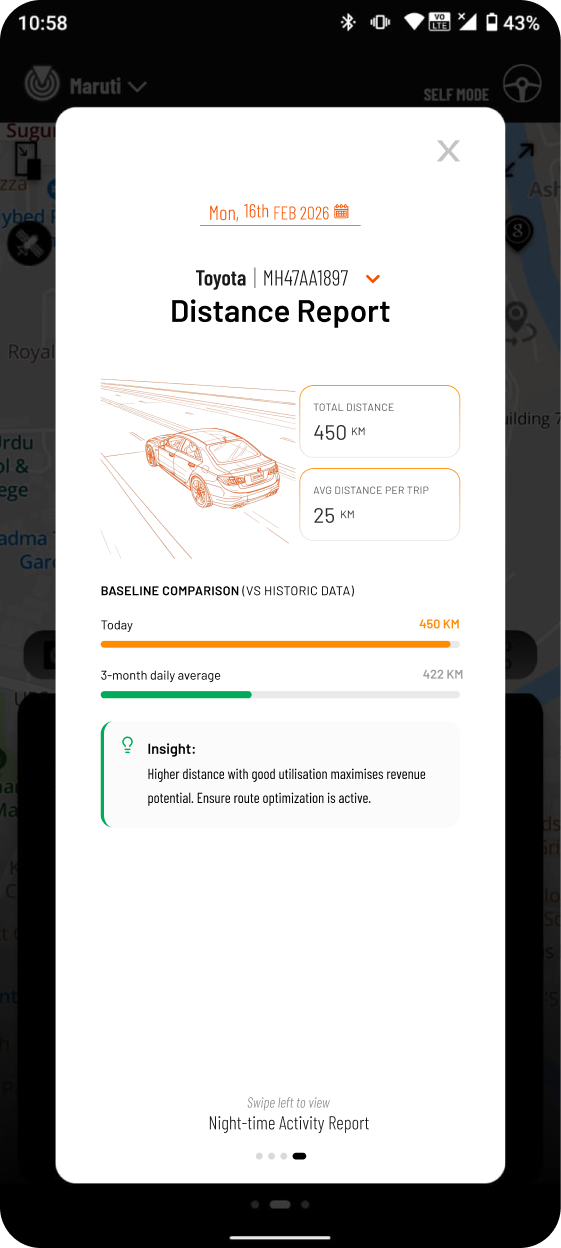
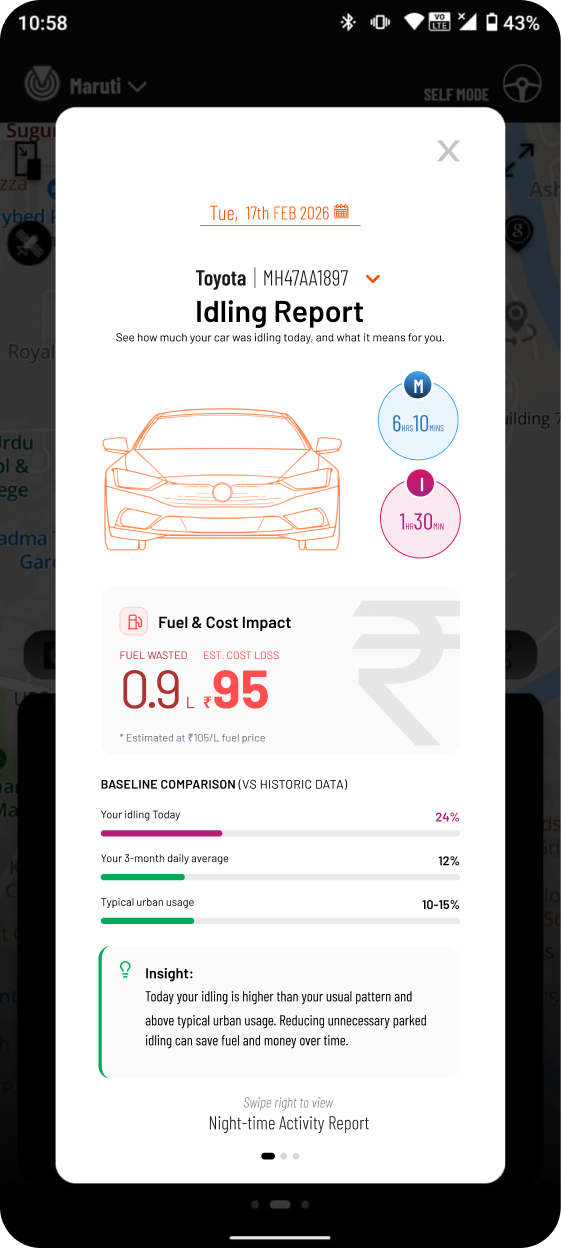
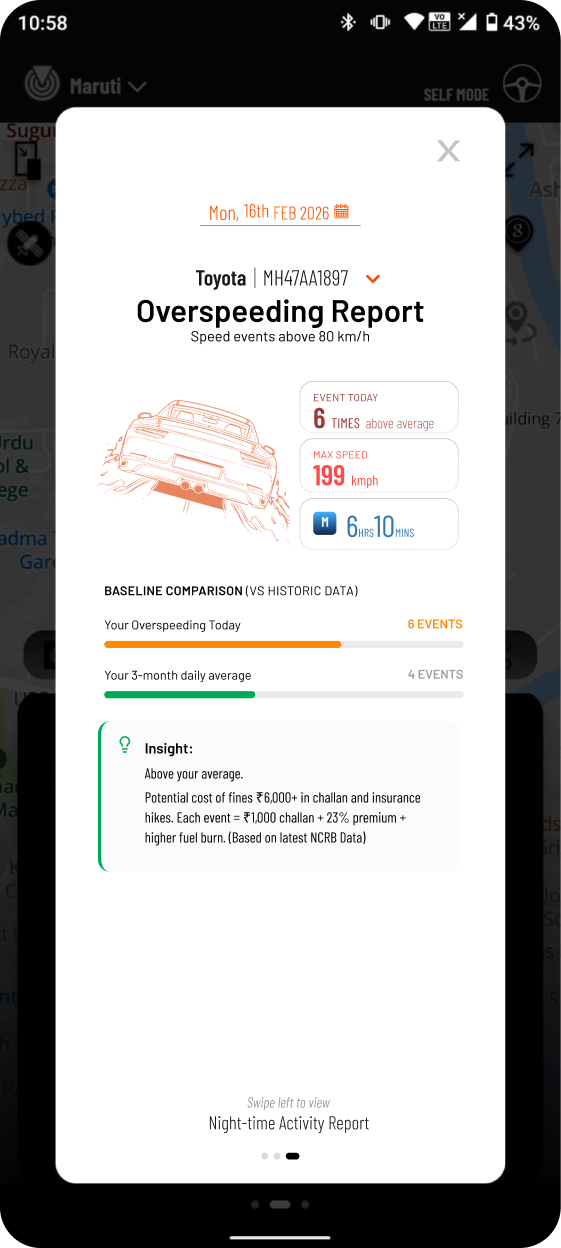
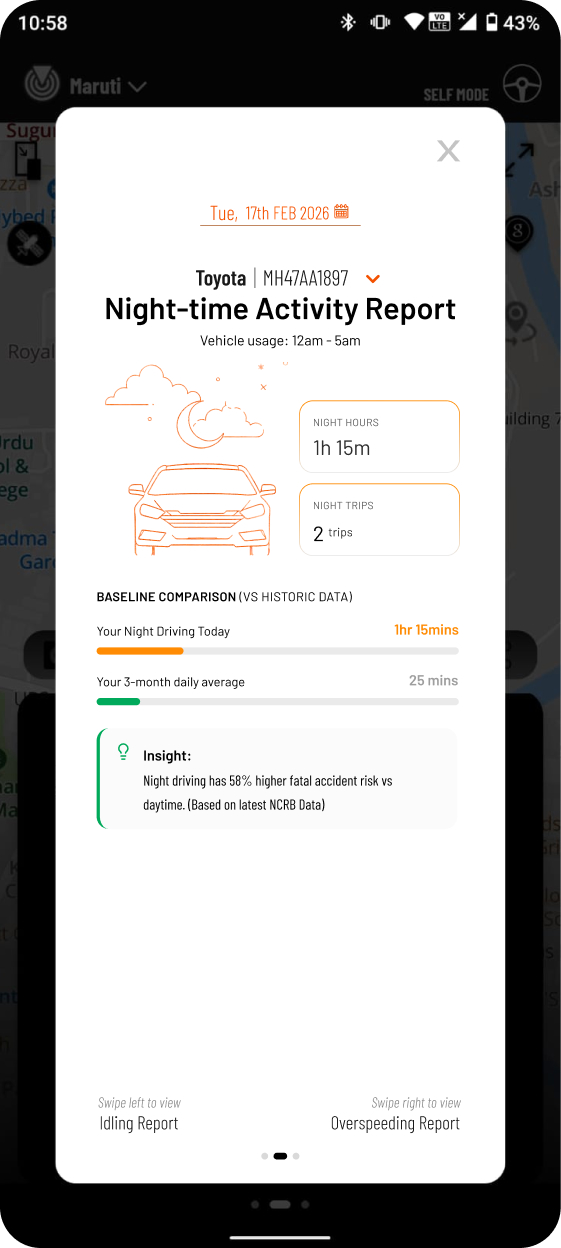
Four in five Swicar customers open the app every month. That is not a utility metric — it is an affection metric. And it is exactly why borrower consent for the lender-facing layer is enthusiastic rather than reluctant.
Parked, idling, or moving — right now. Live odometer. One-tap share-live with any contact.
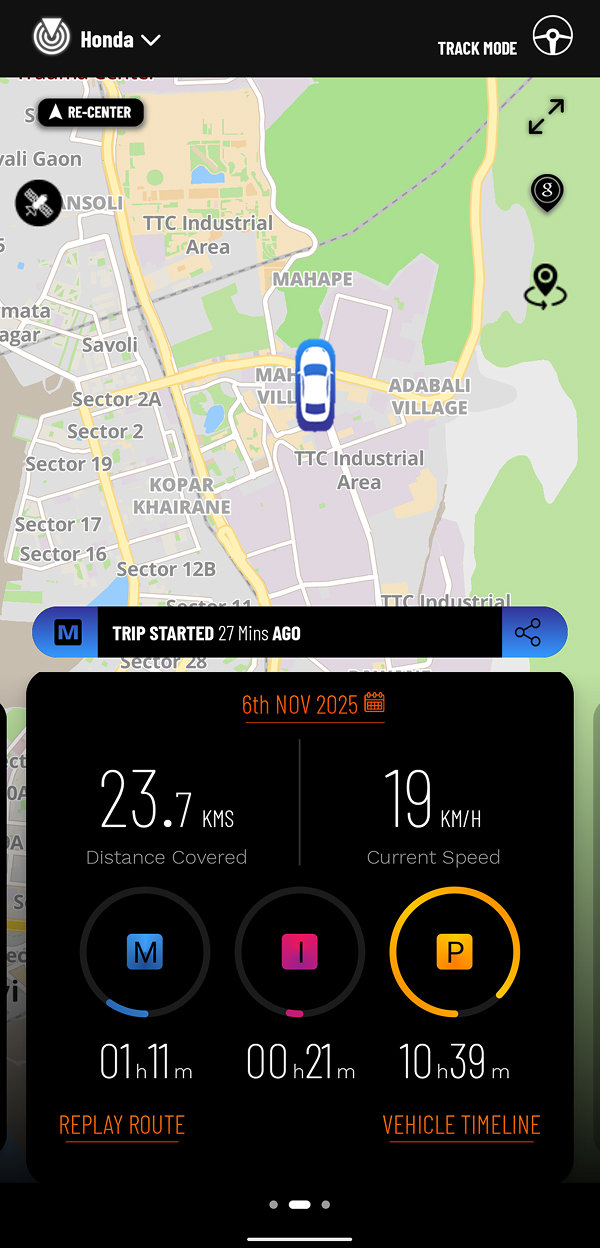
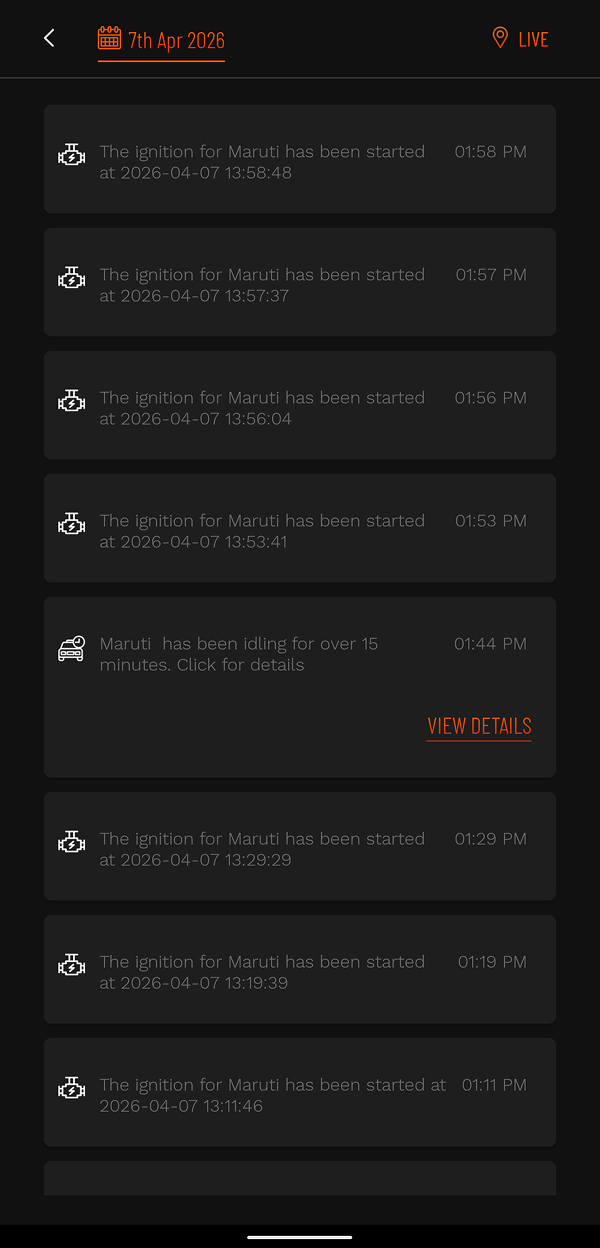
Ignition, overspeeding, excessive idling, and boundary alerts for home, school, service station, customer yard.
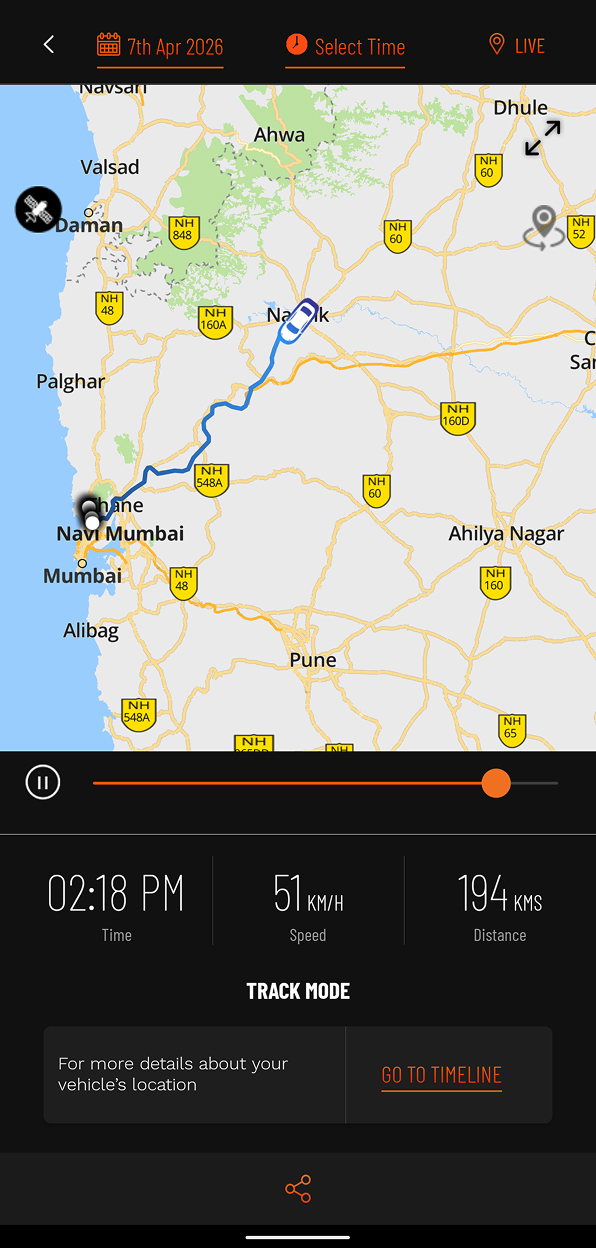
Replayable journey history — proof of delivery for a business, peace of mind for a family.
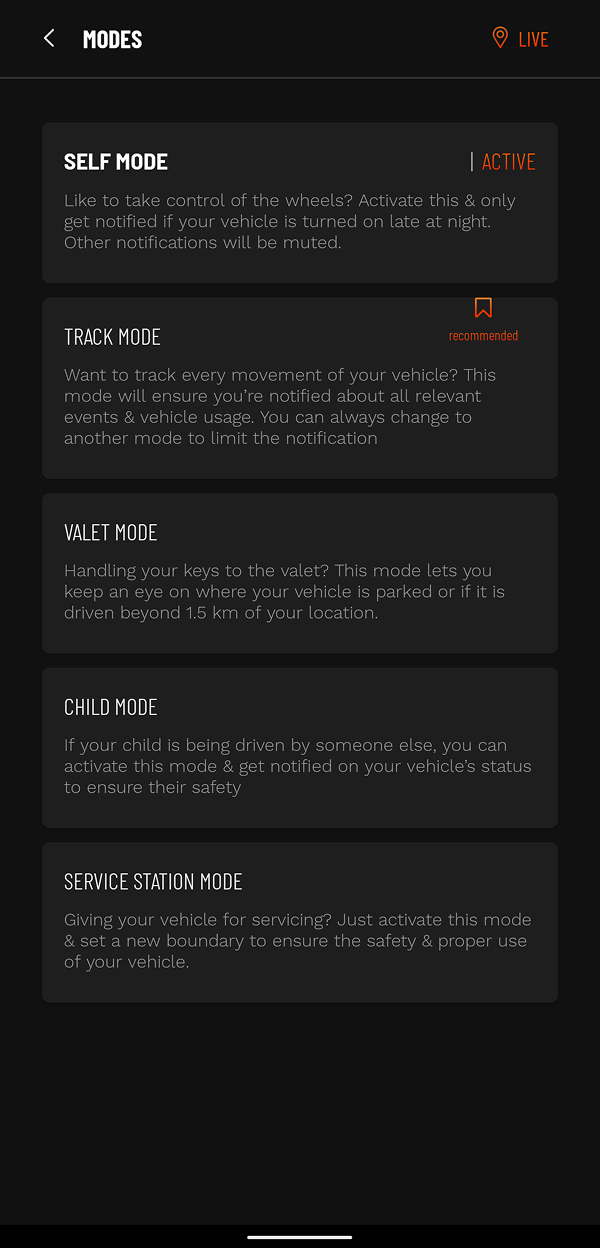
Self, Teen Driver, Valet, Service Station, Elderly Parent — presets for real Indian ownership moments.
At under ₹200 per month — sub-₹150 for many commercial vehicles — Swicar costs less than a single disputed reimbursement, one wasted fuel stop, or one field-verification visit. The borrower receives genuine utility, not a charge they resent. That is the foundation everything in the next three tabs is built on.
Borrower buy-in only matters if the device is in the vehicle on the day the loan disburses. Fifteen years of Swicar’s own installation network makes that routine, not aspirational — there is no gap between disbursement and activation.
Same-day installation in most metros; 24 to 48 hours in Tier 2 and Tier 3 towns — at the dealer, the branch, or the borrower’s doorstep. Lifetime hardware warranty, built-in tamper detection, support in 10+ Indian languages. The vehicle is live — for the borrower and for the lender — from Day 1 of the loan.
autofinTELL was designed to sit inside a lender’s existing risk and compliance posture, not beside it. The borrower consents, the charge is disclosed, the data is purpose-limited — and the resulting capability is precisely the kind of continuous monitoring and early-warning system Indian regulators have consistently asked vehicle lenders to build.
The borrower must affirmatively consent to data collection and monitoring at loan origination, with clear disclosure of the purpose and scope of data use, and a welcome call in their language confirming it verbally before activation.
Processing is limited to stated purposes with the customer as data principal: valid, specific, informed consent; a compliant privacy notice; data minimisation; and a mechanism to withdraw consent.
No personally identifiable information or live location is shared without customer approval. Data is shared with the lender only for the agreed risk-management purpose — with limited exceptions for loan default (protecting secured-creditor rights) or lawful requests.
All autofinTELL dashboard access is logged to industry standards with regular security audits — a clean audit trail for the lender’s own compliance and supervisory reviews.
autofinTELL underwrites no risk, creates no financial entitlement, and intermediates no financial transaction. It is a services agreement for the lender’s own risk-management function — not a financial product distributed to the borrower.
Analogous to a valuation report, a title search, or a CERSAI charge registration — for the lender’s benefit, recovered as an incident of the loan.The platform serves the lender’s portfolio-risk objectives — an Early Warning System of the type the regulator has encouraged. The borrower’s genuine app benefits are real, but they do not change the arrangement’s character as a lender-side risk tool.
Swicar charges a flat service fee. There is no commission linked to loan disbursement, loan amount, or any financial outcome — the defining feature that distinguishes this from a bancassurance-style cross-sell arrangement.
The under-₹200/month charge is a fixed, predictable amount disclosed in the Key Fact Statement and sanction documentation as a named portfolio-monitoring service fee — directly related to credit administration, and not insurance.
Not insurance: there is no uncertain triggering event, no contingency payout, and no risk transfer under the Insurance Act, 1938.A well-run finance shop is asked to keep a tighter lid on its assets and defaults and to build early-warning signals where the portfolio may experience distress. That is the same posture autofinTELL delivers operationally.
Vehicle location intelligence validates customer-declared data, strengthening KYC beyond the document at onboarding into continuous verification.
Real-time monitoring of the financed asset, aligning with evolving regulatory expectations for ongoing collateral oversight.
Usage-pattern deviations flag potential stress early — the EWS posture the regulator has asked lenders to maintain for exposure accounts.
Location intelligence shortens recovery timelines and helps reduce NPAs — protecting the book and the regulator’s asset-quality concern at once.
The pilot is sized small enough to contain risk, large enough to produce meaningful behavioural signals on your own borrower book, and structured to make a go / no-go decision defensible with data after roughly 60 to 90 days. Initial pilots typically target 1,000–3,000 units per month.
A contained cohort of new originations in a single market you select. The existing book is not touched.
Segment is your call — commercial vehicles, used passenger vehicles, or a blended cohort — framed by which segment the pilot is designed to stress-test. Each choice surfaces a different signal mix.
Every borrower receives a welcome call from Swicar support in their language — Hindi, Marathi, Gujarati, Tamil, Kannada, Telugu, Bengali, English, and more — walking them through the app and confirming consent verbally before activation.
Ongoing support in the same language, by phone or WhatsApp, through the entire loan tenure.
Swicar-certified technicians install at the dealer, branch, or doorstep. Same-day in metros, 24–48 hours in Tier 2 / 3. Lifetime hardware warranty.
The platform is live within minutes — the borrower sees the app, you see the autofinTELL dashboard, from Day 1.
Credit, Collections, and Compliance from your side; Product, Legal, and BD from Swicar. One working session to align on scope, success metrics, and timeline.
The pilot runs through an internal review gate before any broader rollout. Commercial structure is discussed only after pilot performance is established.
The full pilot kit — installation rollout plan, customer onboarding playbook, and multilingual welcome-call team — is in place. A single thirty-minute working session is usually enough to align on pilot parameters. Don’t just lend and hope. Lend and know.